Heated Rivalry: When Desire Refuses to Wait
Can queer hockey smut heal us?

“He deserves sunshine. And so do you.”
-Elena, Heated Rivalry episode 3
It was some time before Thanksgiving that the videos started popping up on my TikTok FYP. A new Canadian gay hockey TV show—based on a series of romance novels—was about to premiere. I was already thinking about getting a VPN to watch when it was announced that Heated Rivalry would also be airing on HBO Max. The algorithm, as usual, knew me well and had me covered.
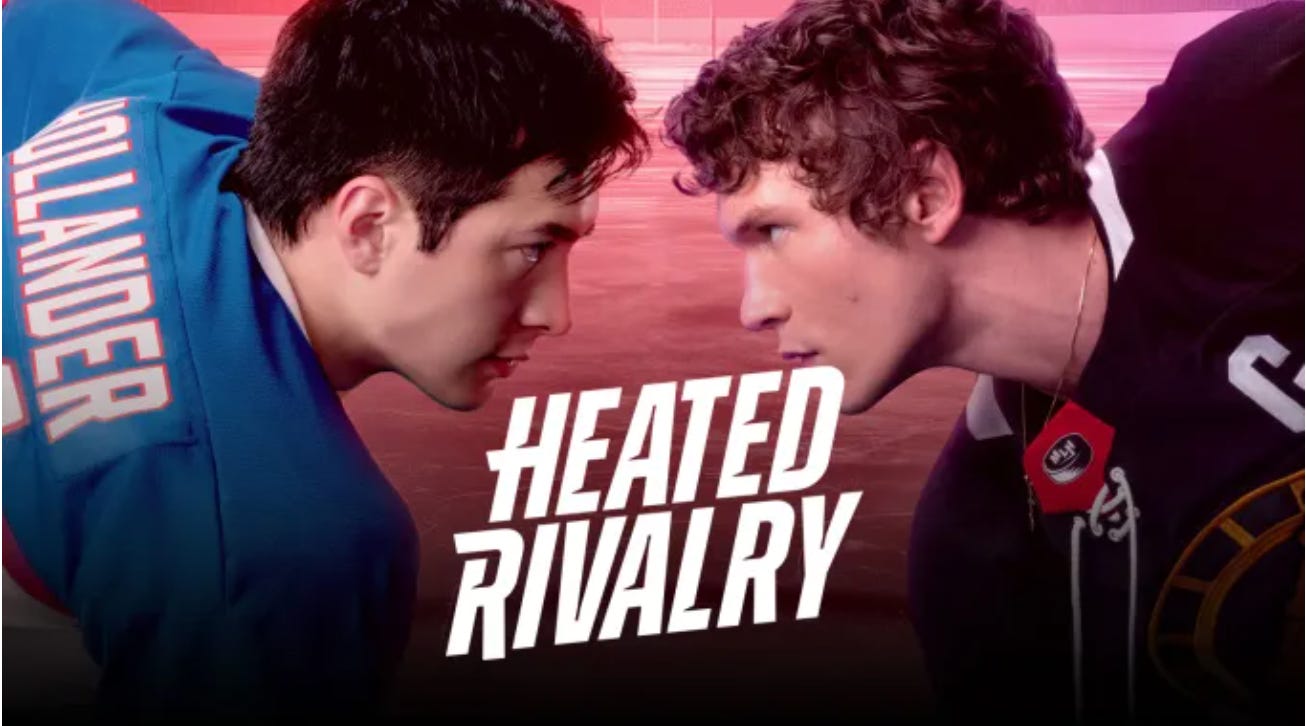
In the intervening weeks, Heated Rivalry has become a full-blown cultural phenomenon. What began as a trickle of posts quickly turned into a torrent of reaction videos, fan edits, cultural discourse, critique, and celebration from both longtime readers of the books and a whole new audience of TV viewers. And now, inevitably, it’s time to add my own thoughts to the mix.
The earliest reactions were almost entirely about the sex. In case you’ve been living under a rock, Heated Rivalry includes some very explicit sex between rival hockey players Shane Hollander (Hudson Williams) and Ilya Rosanov (Connor Storrie). Many of the first reaction videos I saw—mostly from women—expressed genuine shock that the first sex scene occurs just seventeen minutes into the series premiere.
I was delighted by the reaction (and the episode), but I wasn’t surprised that these two men acted on their desires before really getting to know anything else about each other. For many queer men, physical intimacy is often the first point of connection. It can be a space of safety and honesty in a world where it’s often not safe to be different. Relationships can grow from that initial connection, upending the dominant romantic structures we’re taught growing up and repeatedly reinforced by mainstream media.
I used to joke in college that when a guy goes on a date with a woman, he’s often wondering if they’ll have sex while she’s there to say “no,” but when a guy goes on a date with a guy, there’s no one there to say “no.” It’s an oversimplification, of course, and doesn’t account for the full spectrum of gender and desire, but the underlying point still holds. When one lives outside of the dominant structures of heteronormative patriarchy, one has to make their own rules. Historically, queer men had to optimize for speed, safety, and secrecy in order to connect. This is adaptive behavior in constrained environments. When traditional courtship rituals are unavailable or dangerous, humans innovate new pathways to connection. That’s not deviance, it’s evolution.
The sex in Heated Rivalry is not gratuitous. It is story. It’s the one place where these characters can be entirely themselves. By diving into intimacy early, the series upends the familiar straight romantic arc—the drawn-out “will-they-or-won’t-they,” the prolonged yearning, the final consummation as narrative reward. Here, desire is established almost immediately. The tension shifts instead to a more interesting question: How can these two men be together in the hypermasculine world of professional sports, and in mainstream culture more broadly? And somewhat unexpectedly, mainstream culture seems to have embraced these fictional hockey players over the last few weeks.
What’s striking is that intimacy-first bonding isn’t even uniquely human. A 2023 study of wild male rhesus macaques found that same-sex sexual behavior was not only common—observed in roughly 72% of males—but socially advantageous. These encounters weren’t simply dominance displays; they formed the basis of alliances that helped individuals gain access to mates and ultimately increase offspring. Most males were behaviorally bisexual, using intimacy as a tool for trust, cooperation, and social cohesion. Similar observations have been made in bottlenose dolphins, among the most behaviorally bisexual nonhuman animals studied. In dolphins, same-sex sexual behavior (especially among males) plays a role in bonding, alliance formation, conflict resolution, and play.
Animal behavior doesn’t dictate human morality, of course, but it does challenge the persistent myth that sex is meant strictly for procreation and that intimacy outside rigid, prescriptive, heteronormative scripts is somehow unnatural.
Jacob Tierney, who adapted Rachel Reid’s book series and directed all six episodes, understands this. I haven’t read the original book series as I don’t tend to read much MM romance. When I do, I usually gravitate towards male authors, not because women are incapable of imagining queer desire, but because lived experience can shape nuance in ways that matter to me as a reader. I’m also aware of the irony here as someone who’s biggest claim to fame is writing a lesbian musical. But I believe that all entertainment is a collaborative medium and just as it was important for us to have a queer female director, Tierney (who is openly gay), and his cast bring an authenticity to this piece that is important.
I’ve also been genuinely surprised by the number of women—particularly straight women—who are deeply invested in this show, and in MM romance more broadly. I had no idea that hockey romance was an entire subgenre, though in retrospect it makes sense (add it to the list of Canadian cultural exports alongside Ryan Reynolds, SCTV, and unironic politeness). It isn’t just the LGBTQ+ community that’s turned Heated Rivalry into a hit. It’s popularity has earned it an early season 2 renewal and a level of mainstream attention that queer shows don’t always receive.
That attention has even spilled into the real-world NHL, which has aired clips from the series and played songs from its soundtrack at recent games. Women and queer fans are showing an interest in hockey—sometimes now referred to as the “boy aquarium”—much like how Taylor Swift’s romance with Travis Kelce brought a lot of new young women viewership to the NFL.
The fifth episode of the season, which dropped on Friday, has been praised by critics and fans alike as one of the best episodes of television this year, and I couldn’t agree more. Without giving anything away, it’s the most emotionally rich episode so far. It smartly includes no onscreen sex at all, instead highlighting the incredible work Williams and Storrie are doing on screen. The episode culminates in an unmistakable moment of queer joy—one so moving that it’s made the final episode, airing December 26, my most anticipated Christmas gift.
There has of course been some internet backlash (It is, after all, 2025 in Trump’s America). To the “Why does everything have to have gay characters now?” crowd: queer people—who have always existed—grew up watching straight romance almost exclusively. On television, in movies and in the world around us. Seeing our stories represented on screen isn’t saturation; it’s repair. And it turns out queer joy isn’t a niche emotion, simply a human one. In nature, systems thrive not through sameness, but through diversity and connection. Maybe it only took a gay hockey smut show to remind us of that truth.
SMART