Lessons Learned from Frances Perkins
How the first female U.S. cabinet ember can inspire a new generation

Hey guys, as we head deeper into the semester, my grad school coursework has picked up and sadly I haven’t had time to write something new this week, so I’m going to share something I wrote for my Social Welfare Policies class about Frances Perkins, the first female US cabinet member, under FDR, and one of the main architects of The New Deal. I’m sharing this because I had never heard of her and I’ve become a bit obsessed and think more people should know her story. Also just a gentle reminder that Democratic Socialist policies have worked in the past. Let me know if you knew anything about Perkins before today!
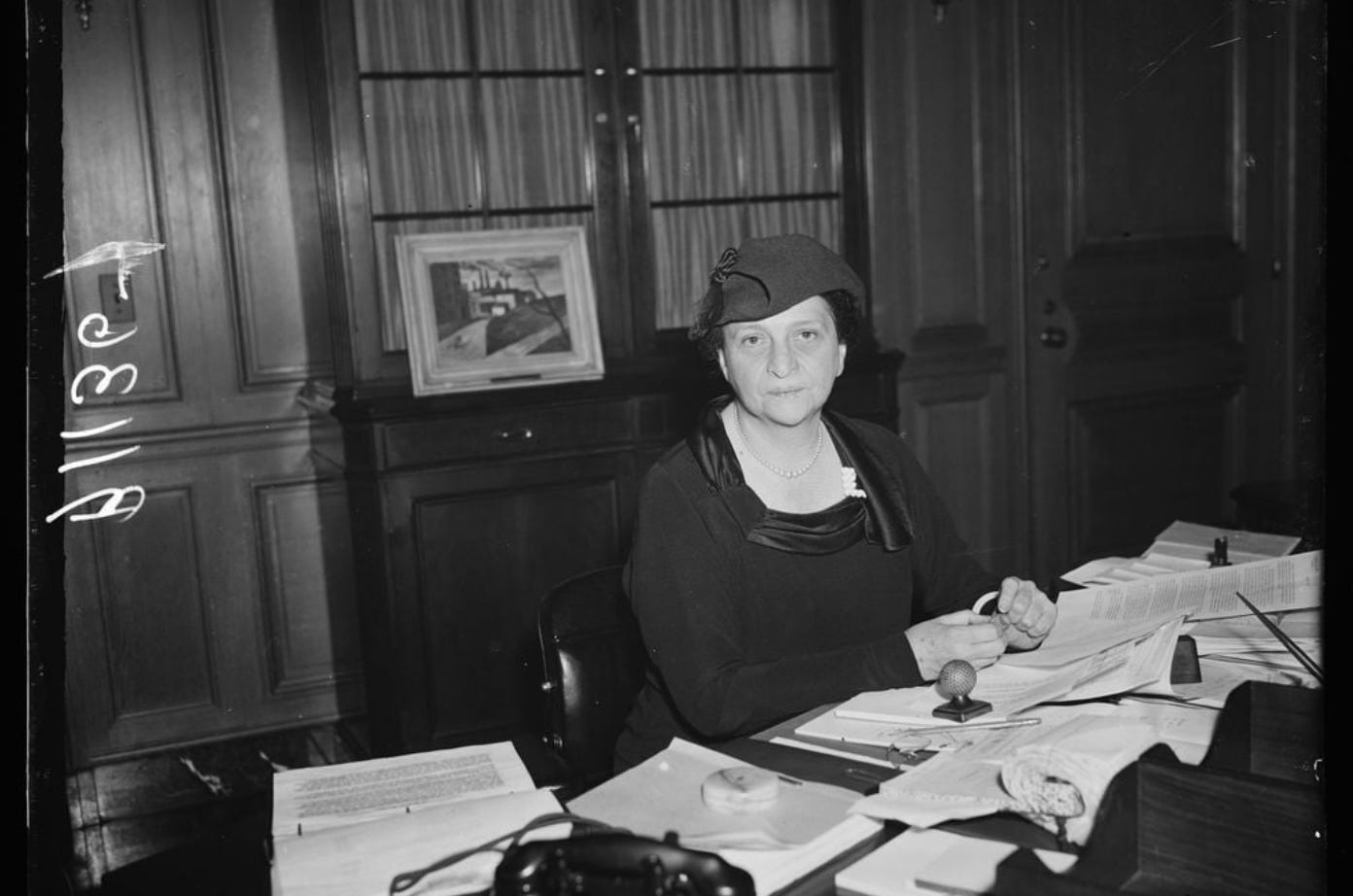
Frances Perkins was the first female cabinet member in U.S. history, serving as Secretary of Labor under Franklin D. Roosevelt from 1933 to 1945 (one of two people to serve his entire term). A wife and mother, social worker, a tireless advocate for workers’ rights, and one of the main architects of The New Deal, Perkins was as historian Kirsten Downey refers to her, “the most effective progressive—male or female—in American History.” I’d have to agree as so many of the policies and protections she helped create, from fire safety regulations to Social Security, remain pillars of American life nearly one hundred years later.
Born Fannie Coralie Perkins in Boston, Massachusetts in 1880, Frances would change her name when she changed her religion (from Congregationalist to Episcopalian) some years later. After attending Mount Holyoke College, she moved to Chicago to teach and began volunteering at settlement houses, including Hull House, where she met Jane Addams, who would become a mentor. In 1907, she moved to Philadelphia to study economics at Wharton. She spent two years working as a social worker, before moving to New York to earn a master’s degree in sociology and economics at Columbia.
New York City would prove life changing. Witnessing the gruesome 1911 Triangle Shirtwaist Factory fire—where 146 workers, mostly young immigrant women, died—clarified her mission. On Theodore Roosevelt’s recommendation, she joined the Committee on Safety of the City of New York, whose recommendations on fire safety are still in place today. Reluctant to pursue politics yet driven by conscience, Perkins became one of the most effective labor rights advocates of the 20th century.
When Franklin Roosevelt asked her to serve as Secretary of Labor, she accepted only on the condition that he support her agenda: a 40-hour workweek, a federal minimum wage, workers’ compensation, unemployment insurance, the abolition of child labor, social security, and national health insurance. With FDR’s backing, she achieved all but the last. Her leadership also shaped public works projects and mortgage reforms; measures that lifted millions (mostly white Americans) out of the Depression and rebuilt the economy.
The New Deal’s sweeping initiatives, banking reforms, labor protections, rural electrification and cultural projects (plus laying the groundwork for future liberal reforms like the GI Bill, Medicare and Civil Rights) are often thought of as “saving capitalism.” I would argue that the New Deal saved capitalism from itself. By imposing regulations that curbed exploitation and stabilized markets, the New Deal allowed for more equitable upward mobility and slowed the extreme income inequality that had started in the Gilded Age.
In that sense, the 1930s were very much like today. Many protections that sustained the American middle class have been dismantled over the past fifty years, fueling a new era of wealth concentration. A new billionaire class has bought the US Government (thanks in large part to the Supreme Court’s Citizens United ruling in 2010) and continues to erode the balance Perkins fought to establish.
When the economy inevitably implodes once again, I hope that new figures like Frances Perkins will rise—leaders grounded in moral conviction, guided by compassion and practical reform—to help us rebuild an economy that once again serves the many to sustain future generations.
Any thoughts on who that might be?
Yeah, she was forward thinking, like so many people working for the betterment of all rather than for a “just” few.
What damage has spawned such a horrible human soul known as djt?