The Worst Generation?
A story of growth, decay and the American Dream

OK Boomer.
—Chlöe Swarbrick, New Zealand Parliament, 2019
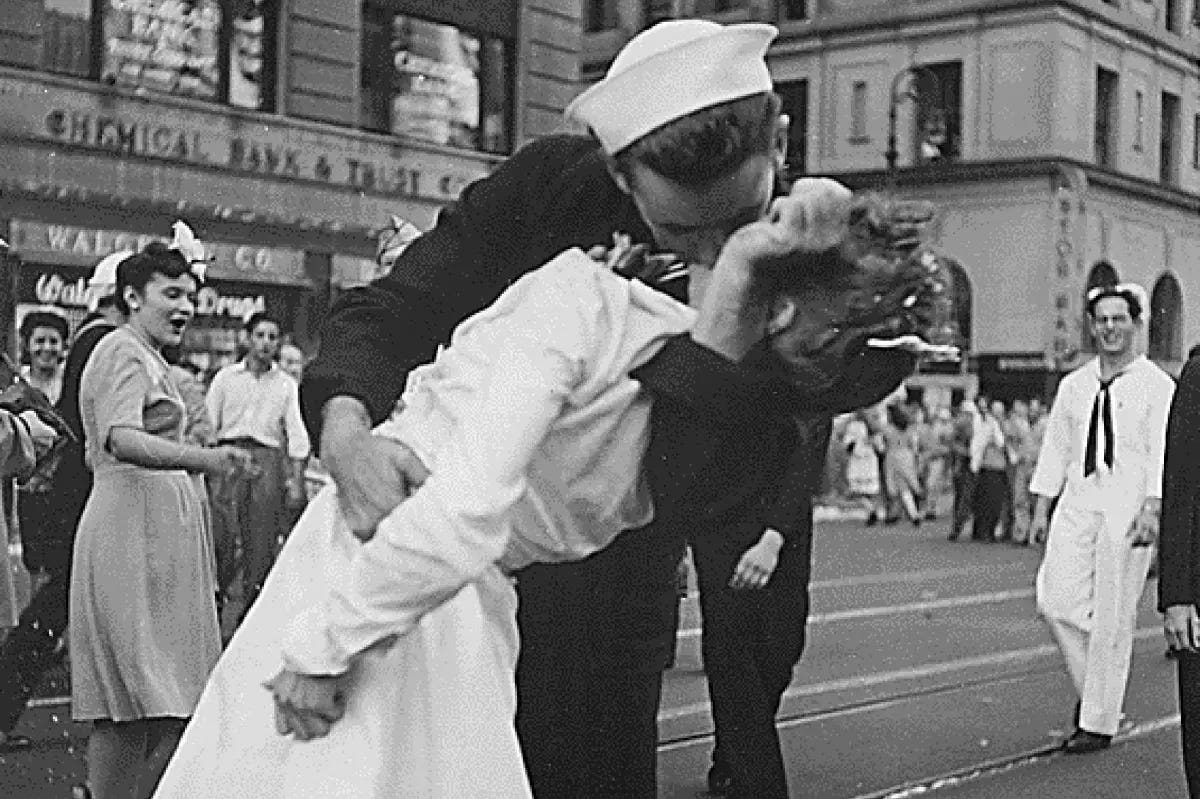
I find myself having a lot of conversations with friends lately that eventually lead to the question “What happened to our parents?” I’m in the cohort of Generation X (born between 1965-1980) and our parents are typically Baby Boomers (born 1946-1964). We grew up watching them chase success, accumulate stuff, and avoid hard emotional truths, while telling us exactly what we needed to do to be successful—and any choice, desire, dream of ours that deviated from that stringent definition of success, was judged and deemed unworthy.
I’ve been struggling to write this piece. My friends and I aren’t having these conversations to be cruel. We’re not even trying to be smug. Our parents are people we love. People who raised us. Who made sure we had food and birthdays and bikes and piano lessons. But—at least anecdotally—we find them to be unpresent, emotionally immature, money-obsessed and unable to do any self-reflection or take personal responsibility for their actions.
And this is the generation that is currently running our country (our President, 40% of Congress, 60% of the Senate and 5 out of 9 Supreme Court Justices—plus at least 50% of Federal Judges are Boomers), unwilling to retire and give up power. With an astounding $78 trillion in net wealth, Baby Boomers account for more than half of the total wealth in this country. And they created the laws and economic policies that have enabled them to hoard and grow that wealth while leaving future generations well behind.
Post World War II, policies like the GI Bill, Interstate Highway Act, and government-backed mortgages through the Federal Housing Administration and Veterans Administration, fueled the postwar suburban housing boom—at least if you were white. Progressive taxation, high union membership and strong labor protections all continued to build on the New Deal safety net (Social Security, unemployment insurance, minimum wage laws, and public housing), creating the idyllic middle class MAGA mythologizes—while railing against the very socialist policies that built it.
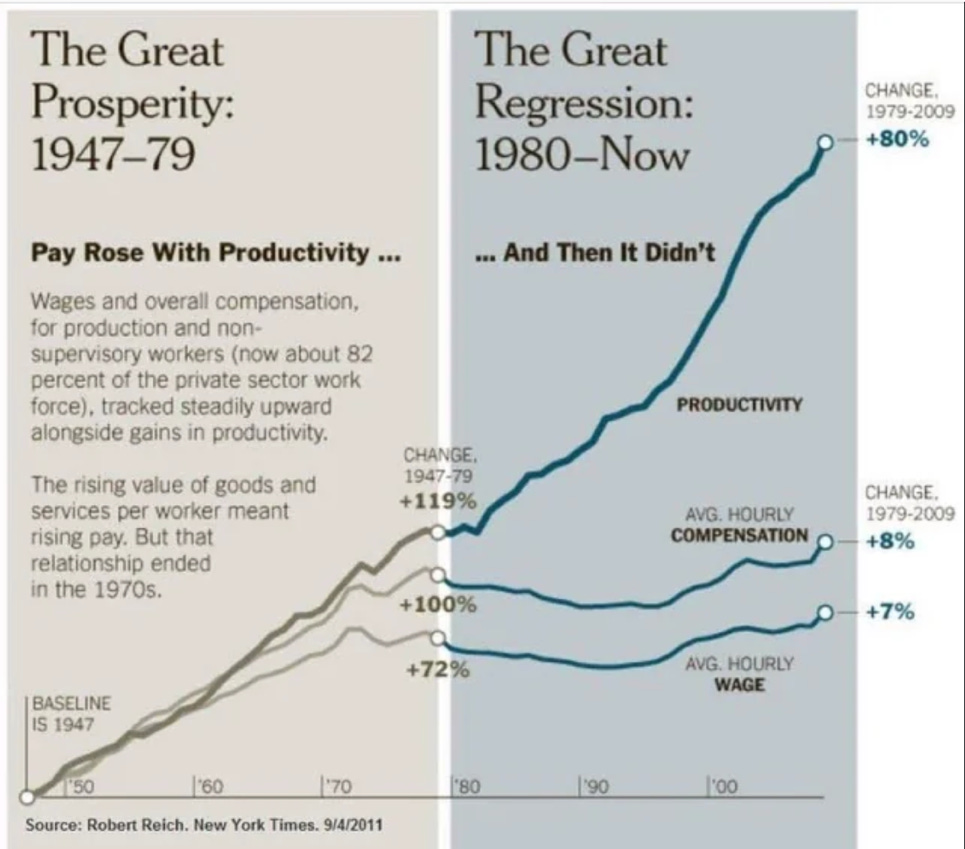
In the first three decades after World War II, the typical American’s pay rose in tandem with the nation’s growing productivity. But then, starting in the late 1970s and dramatically after 1980 (boomer leadership and Reaganomics), pay barely grew, even as productivity continued to soar. Boomers didn’t build the middle class—they inherited it. And once they had it, they pulled the ladder up behind them.
Their parents, who lived through the Great Depression and fought in World War II, are known as “The Greatest Generation.” So what did they do to fuck up their children so bad? Is it possible that the Greatest Generation… raised the Worst?
I always figured, having lived through the Depression, they would have instilled the importance of money in their children, so that piece wasn’t a mystery for me. However, I came across a quote in Tom Brokaw’s book The Greatest Generation that I think begins to answer some other pieces.
“The WWII generation shares so many common values: duty, honor, country, personal responsibility… it was the last generation in which, broadly speaking, marriage was a commitment and divorce was not an option.”
Brokaw states this without irony and even with reverence, but if you tilt it slightly, it reveals the shadow side of the Greatest Generation’s values: rigidity, repression, and performance over authenticity. They didn’t talk about feelings; they talked about duty. They didn’t process trauma; they buried it. They didn’t model emotional openness; they modeled stoicism and compliance.
The Greatest Generation returned from war and, rather than unpack their trauma, built a world where trauma had no place. They believed in institutions—marriage, church, country—not necessarily because they were always good, but because they provided order.
The WWII generation had been through A LOT. Don’t forget that prior to the Depression, they had lived through the last global pandemic (Spanish Flu), their early lives were shaped by the echoes of WWI and then they watched/participated in the entire reshaping of the current world order, and witnessed firsthand the devastation of the Atomic Bomb. It is no wonder they wanted to raise their children in a veneer of normalcy after the chaos of the previous 30 years.
But their children grew up in a much more stable and economically prosperous time, without the hardships that their parents lived through. Boomers were raised to perform “normal” rather than feel or question it. They inherited the rules without the resilience, the expectations without the wisdom.
If the Greatest Generation built the stage set of the American Dream, the Boomers became the actors who forgot it was theater. They were told marriage was forever—but weren’t shown how to communicate. They were told to raise children—but weren’t allowed to access their own inner child. They were told to pursue prosperity—but weren’t given tools for self-reflection.
So instead of evolving, they overcompensated: chasing wealth as a proxy for worth, hoarding power to feel in control, avoiding accountability the way their parents avoided vulnerability.
Instead of understanding money as a tool, they came to see it as a measure of moral worth, social status, and personal freedom. They built a society that worshipped individual wealth and privatized everything from healthcare to education. They didn’t fear poverty—they feared taxes.
This mindset is what seeded the roots of late-stage capitalism we are currently living through: Financial deregulation in the 1980s, union busting and wage suppression, housing as investment, not shelter, healthcare as profit center, not public good. All built on the misinterpretation of their parents’ fear:
“Don’t go without” became “never have enough.”
Boomers didn’t just benefit from capitalism, they reshaped it in their own image, stripping it of its restraints and declaring that the market would replace the village. Through this lens, the ascendency of Donald Trump makes so much more sense. He is not an outlier to the Boomer generation; he is emblematic of them. Emotionally immature, deeply racist, obsessed with power over all else, and most importantly, always putting on a show.
In ecosystems, balance matters. Organisms take only what they need. When one species over-consumes, it triggers collapse—not just for itself, but for everything around it. What the Boomers did—consciously or not—was build an extractive culture that violates nature’s core principle: reciprocity.
I don’t believe these current systems are sustainable for the future of society or the planet. Future generations who will inherit trillions of dollars in debt accumulated during Boomer-led decades, will need to work for decades—possibly centuries—to align us with a more equitable future.
Churn is an important concept in nature. When a tree falls in the forest, sunlight crashes through the hole in the canopy and new trees can race upwards to replace it. Even in our own bodies, cells die and are replaced by new cells.
I think we need to push for mandatory retirement of all federal workers by age 75. We have been fighting the same battles for 50 years now because the same people are in charge. And retirement doesn’t necessarily mean the end of a career if an individual wants to continue to work.
Mentorship, education and care are all behaviors we see modeled in nature from older members of individual species. Nature keeps elders around long enough to pass on hard‑won knowledge, then lets them exit gracefully. Studies on elephants, orcas, even human grandmothers and other long‑lived species show older individuals carry cultural memory that keeps the group stable, yet even they face natural mortality—no matriarch reigns for a century.
Mentorship is part of the CARING system that all mammals inherit as part of their primal behaviors. If our parents’ generation cannot connect with that primal instinct, it will be up to us, both men and women (we also need to unlearn the myth that nurturing only belongs to the females of the species).
I want to caveat a couple of things here: Obviously not all boomers drank the Kool-Aid and fell into these traps. A lot of the economic points I’ve included come from professor, political commentator (and boomer) Robert Reich, who served as economic advisor to Obama. Jane Fonda, Bruce Springsteen, Barbra Streisand, Dolly Parton, Angela Davis, and George Takei all saw through the story they were being told and shaped their careers to address the inequalities they witnessed. Also, my generation and future generations are not blameless in this current society. After all, Elon Musk, the world’s wealthiest Nazi, is also Generation X. And of course, there was just the Young Republican Leadership chat that seems to adhere to the same worldview.
Younger generations have stood witness to the lies Boomers told us for decades, like trickle-down economics, privatization of everything, punitive criminal justice, and rugged individualism. It will be up to us to reshape the society that these lies leave behind. It will be an enormous task, and I hope we can follow the lessons of nature and find the courage and perseverance to build something better. After all, nature doesn’t cling to the past—it composts it. And from that decay, something new can grow.
Bill, I think this one is fantastic! So many great points.
The New York Times is on the exact same page as you today with this opinion video: https://www.nytimes.com/2025/10/17/opinion/baby-boomers-us-generations.html?smid=nytcore-ios-share&referringSource=articleShare
I’ve been saying the boomers ruined the country for a while and they refuse to stop ruining it!